
Work avoided
The first gain is not a better material. It is less unnecessary material movement where the project design allows it.
What is HydroFoamer?
HydroFoamer is a controlled installation method for restrained buried pipelines. It uses engineered sprayed polyurethane foam, measured field control and auditable as-built evidence to reduce the construction activity normally required around the pipe: imported aggregate, handling, access pressure and buried uncertainty.
The first gain is not a better material. It is less unnecessary material movement where the project design allows it.
Sprayed structural polyurethane foam creates a defined support geometry around the pipe instead of relying only on imported bedding and embedment.
Pipe position, alignment and installation records can be captured before the installed condition disappears underground.
Productivity in infrastructure is not achieved by adding steps. It is achieved by removing work that does not need to be done.
HAPI — the wider system
HydroFoamer begins with a change to the physical installation method, but the consequence is much larger. By replacing a variable, manually constructed support environment with a controlled engineered structure, pipeline installation becomes measurable, repeatable and ultimately automatable.
The HAPI film explains the complete system.
If the player is unavailable, Watch the HAPI film on YouTube.
Support geometry
The HydroFoamer keyhole geometry puts engineered support where it is needed and allows native backfill to replace much of the imported bedding and embedment material normally specified. The foam is the enabling mechanism. The management value is in the activities that can disappear.
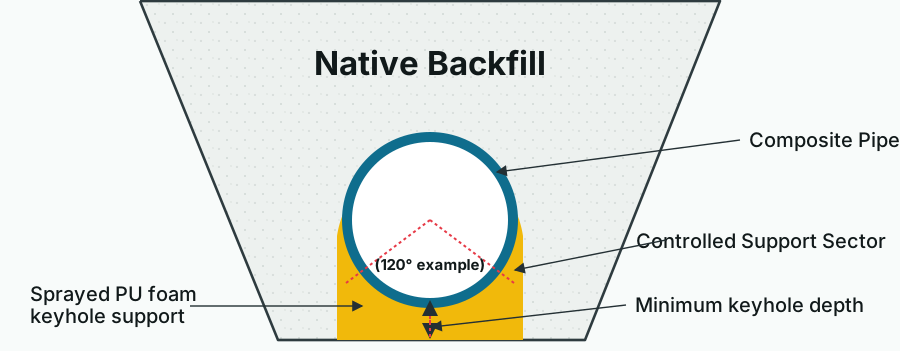
HydroFoamer changes the basis of comparison. The question is no longer only which pipe is selected, but how much construction activity is required to deliver the pipeline.
The project buys, hauls, stores, places and compacts large volumes of selected material around the pipe.
Engineered foam support can reduce selected material demand and the transport, access and handling activity attached to it.
Quality depends heavily on site execution, compaction, access, plant movement and checks that vary along the route.
Pipe positioning, foam application and restraint are managed as one repeatable installation sequence.
Once backfilled, many important installation conditions are difficult to inspect directly.
Measured installation data can support quality assurance, as-built evidence and a more disciplined handover.
Aggregate supply, transport, spoil movement and temporary access can dominate the environmental footprint.
Where less imported material is required, truck movements, access burden and associated emissions can fall with it.
The questions that matter
A project team does not need a slogan. It needs to know what work disappears, what work remains and what evidence will exist when the pipe is covered.
Compare imported bedding and embedment with native backfill, foam volume and spoil handling under the same route assumptions.
Trace aggregate supply, haul distance, site storage, access roads and on-site material movement before accepting the conventional case as inevitable.
Review whether reduced material handling and a controlled support sequence can reduce exposure to weather, access constraints and HSE burden.
Check what records will exist for pipe position, alignment, foam application, QA hold points and as-built handover.
Engineering evidence
Future Pipe Industries has confirmed that, for HydroFoamer restrained installations where pipe alignment, movement and settlement are controlled and verified, the designer may consider the nominal joint deflection capacity of the pipe system.
That matters because HydroFoamer does not only change the installation method. It changes the uncertainty that engineers must allow for.
Partner business case
HydroFoamer gives pipe manufacturers, contractors and infrastructure partners a way to compete on the total installed pipeline, not only on the pipe. It combines composite pipe, controlled installation, measured field data, digital handover and HAPI-supported project qualification.
For suitable projects, this can expand the addressable market, make constrained projects feasible and create higher-value conversations around execution certainty, data and lifecycle support.
Partners can offer a controlled installation capability, not only product supply.
Reduced construction burden can make remote or constrained projects more viable.
Measured installation data, PGMS workflows and digital handover support stronger QA and lifecycle value.
HAPI assessment, installation support, QA and digital handover create conversations beyond the one-off pipe sale.
Enterprise-value outcomes remain partner-specific and depend on market access, qualification, commercial execution, delivery capability and project pipeline.
Serious project conversations move from the proposition to the evidence: method review, HAPI scenario modelling, engineering evidence or partner discussion.
Review the controlled installation sequence, keyhole support geometry, PGMS workflow and as-built handover route.
Use HAPI to compare the full installation system rather than only the pipe price.
Understand where HydroFoamer is near-term, adjacent or still subject to future qualification.
Review the PGMS, robotic application, IP position and testing evidence behind the controlled installation platform.
Assess sustainability through construction activity avoided, not generic green claims.
Find public resources, controlled technical resources and the FAQ for early project questions.
Project-specific results depend on trench geometry, access, ground conditions, pipe specification, foam design, productivity assumptions and commercial inputs. HAPI makes those assumptions visible.